 Aderson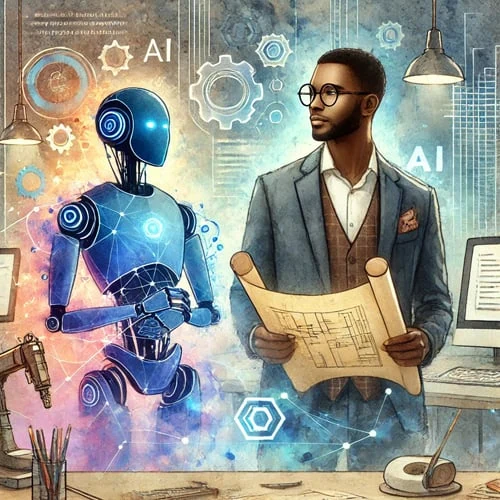
“Are we going to lose our jobs to AI?” — This question is born from fear of the unknown, and honestly, no one can predict exactly what the next 5 to 10 years will bring.
But maybe we’re asking the wrong question. Instead, try asking, “How can I use AI to become a better software engineer?” (Feel free to swap “software engineer” with any profession.)
The first question puts you in a mindset of resistance. The second? It puts you in a position to adapt. Fight against AI, and you risk being left behind.
Embrace it, and you’ll be riding the wave of innovation. There’s always a wave—you just need to learn how to ride it.
Today, I’ll dive into how you can start leveraging AI right now to grow as a programmer. Enjoy the read, and let’s ride this wave together!
Aderson.
— Are you worried AI will take over your programming skills and leave you jobless? You’re not alone. Many programmers fear becoming irrelevant in a world where AI-generated code is getting better by the day. But what if you could **use AI** to make yourself even more valuable instead of competing with it? Here’s the good news: it’s not about fighting AI—it’s about adapting, evolving, and staying ahead. In this post, we’ll explore how you can embrace AI tools like code-generating models to supercharge your skills and remain essential in the tech industry. — ### 🤖 Don’t Compete with AI—Collaborate with It! **AI is not your enemy.** As a programmer, you might be thinking AI is coming for your job, but the truth is, AI is a powerful tool you can leverage to become a more effective developer. Think about it like this: AI can help with repetitive tasks, allowing you to focus on the **big picture**—the creative, high-level decisions that truly define great software. Many programmers feel threatened by AI, but instead of being scared, we need to learn how to **ride the wave** of these advancements. AI can handle the tedious parts of coding, and you can become the **orchestrator**, guiding the AI with your expertise. **The new role of a programmer:** Designers of AI systems, not just code writers. Instead of competing with AI, **learn to use it** to boost your productivity. The key is to work *with* AI, enhancing your workflow and letting it handle the grunt work. — ### 🔧 Master AI Code Tools Like Cursor **It’s time to upgrade your toolbox.** As AI becomes more powerful, there are constantly evolving tools designed to help programmers. Cursor, for example, is an AI-driven code editor based on VS Code. Unlike traditional code editors, it integrates AI seamlessly into your workflow, making code generation almost effortless. You might already be familiar with using IDEs like VS Code, but **AI-powered editors** like Cursor take things to the next level. They allow you to design and generate code using **natural language prompts** instead of manually typing out everything from scratch. This makes it possible to get projects off the ground faster and fine-tune the code where your human expertise shines. Here’s how you can start: - **Stay updated** on the latest AI-driven tools for coding. - Experiment with tools like Cursor to understand how they can integrate into your process. - Practice designing with **natural language prompts** rather than writing low-level code. It’s not about switching from coding to a non-coding role but rather becoming a **hybrid developer**—one who can code, but also knows how to get the most out of AI tools. — ### 🌟 Shift from Coding to Designing with Natural Language Prompts **The future of programming** is moving away from hand-coding every single line and towards **conceptual design**. This doesn’t mean your coding skills are no longer relevant. Instead, they become part of a bigger toolkit that includes working with AI to **design systems** using prompts. Many professionals are now transitioning into roles where they’re **orchestrating AI**, guiding its output with their understanding of the big picture. The idea is to allocate more time to writing **natural language prompts** that instruct the AI to generate code for you, while you focus on **high-level problem-solving** and refining what the AI produces. By designing with natural language, you’re not just doing less work—you’re doing **better** work. The more you collaborate with AI, the more you’ll find yourself focused on the **strategic** and **creative** aspects of development, rather than the repetitive tasks that can be easily automated. So how do you make this shift? - Start by **training yourself** to work with AI tools. Use them to generate code but make sure to understand the underlying logic. - Focus on your **creative problem-solving skills**—something AI can’t easily replicate. - Use your expertise to guide and fine-tune the code that AI generates. Remember: Your value lies in your ability to **think critically** and **design solutions**—something AI is still far from mastering. — ### Conclusion: The AI Era Is Here—Are You Ready? AI is rapidly transforming the programming landscape, but that doesn’t mean it’s time to panic. Instead, see this as an opportunity to **evolve your skillset** and become more valuable in a world where AI is an increasingly dominant force. By mastering AI-powered tools, shifting your focus to high-level design, and using natural language to collaborate with AI, you can **future-proof your career** and stay ahead of the curve. In the end, it’s not about losing your job to AI—it’s about **transforming** how you work so you’re irreplaceable. Cheers, *Aderson* — *“The only way to make sense out of change is to plunge into it, move with it, and join the dance.” —* Alan Watts —
 💼 Struggling to Stand Out? Build a Personal Brand That Lands You the Job!